A Critical Analysis of Institutional Gaps in an Era of Rising Vulnerability
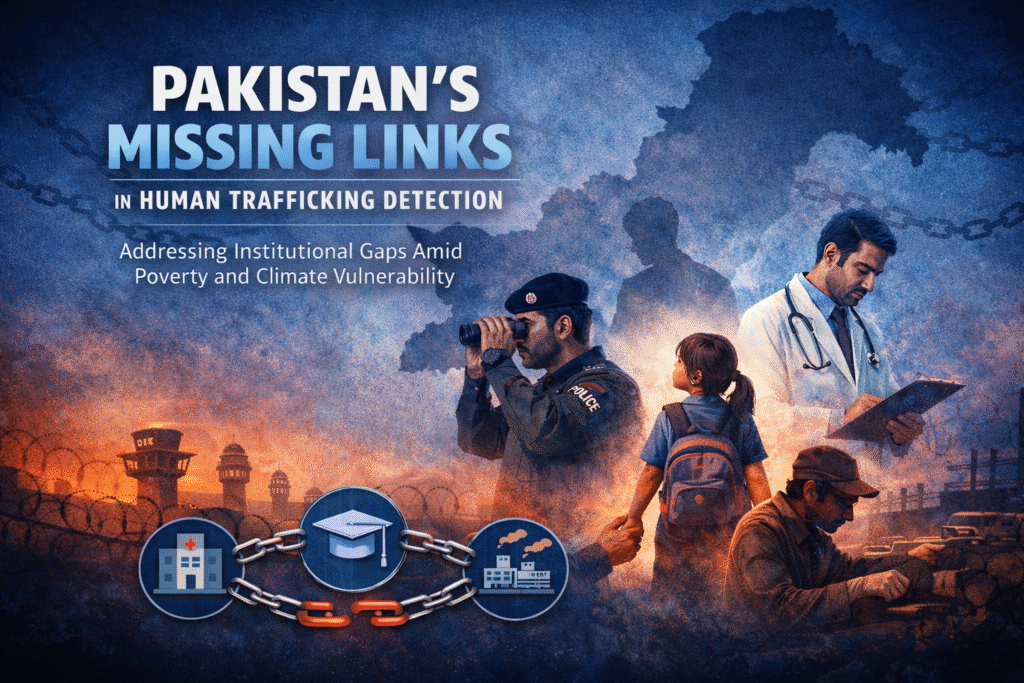
Despite the rapid rise in poverty, climate-induced displacement, and socio-economic instability, the detection of human trafficking in Pakistan has not shown proportional improvement. These structural stressors significantly increase vulnerability to exploitation, yet institutional detection mechanisms remain fragmented and reactive. This gap reflects not the absence of laws or intent, but the absence of coordinated, preventive, and data-driven systems capable of identifying trafficking at its earliest stages
Human trafficking today is rarely visible, linear, or confined to borders. It manifests through forced labour, domestic servitude, child exploitation, and deceptive recruitment practices embedded within everyday systems. The following sections outline the critical missing links that continue to undermine effective detection and early intervention in Pakistan.
- 🩺Healthcare System: An Untapped Frontline
Doctors and medical staff in public hospitals are often the first institutional contact for victims of trafficking, particularly in cases involving physical injury, abuse, or psychological trauma. Despite this strategic position, medical professionals are neither legally mandated nor systematically trained to identify or report indicators of trafficking.
As a result, warning signs such as repeated injuries, controlled communication, or suspicious accompaniment often go unreported. The absence of standard screening protocols and referral mechanisms leaves a critical detection gap at the healthcare level.
Policy implication: Integrating trafficking indicators into emergency and outpatient protocols could significantly improve early identification.
- 🎓Education Sector: Missed Early Warning Signals
Schools are natural observatories of vulnerability, particularly among children at risk of dropout, child labour, or exploitation. However, teachers in Pakistan generally lack training to recognize early indicators of exploitation or trafficking.
Alarmingly, reports also indicate instances where educational environments themselves become sites of exploitation, including the use of children for domestic labour. This dual challenge highlights the absence of safeguarding frameworks, monitoring mechanisms, and accountability structures within the education system.
Policy implication: Teacher training, safeguarding protocols, and referral pathways must be institutionalized across public education systems.
- 🏭Labour Inspection Constraints and Invisible Workspaces
Labour inspectors remain central to identifying forced labour, particularly in high-risk sectors such as brick kilns, factories, and informal workplaces. However, limited mobility, staffing shortages, and resource constraints severely restrict their operational reach.
As a result, many high-risk zones remain effectively invisible to the state, allowing exploitative practices to persist undetected. Without mobility, digital reporting tools, and inter-agency coordination, labour inspections remain reactive rather than preventive.
Policy implication: Strengthening inspection capacity through logistics, digitization, and interdepartmental data sharing is essential.
- 🧑🤝🧑Social Welfare Systems and Weak Coverage
Social protection mechanisms play a preventive role by reducing vulnerability to exploitation. Yet social welfare departments often lack the capacity to ensure regular and adequate coverage for vulnerable workers. Estimates suggest that only 5–10% of at-risk individuals receive consistent social security support.
This limited outreach weakens early protection mechanisms and increases susceptibility to trafficking networks, particularly in informal labor sectors.
Policy implication: Expanding coverage, digitizing beneficiary tracking, and linking welfare data with risk indicators can strengthen early prevention.
- ✈️The “Exit Fallacy”: Over-emphasis on Borders and Airports
A dominant misconception in counter-trafficking efforts is the over-association of trafficking with cross-border movement. Excessive focus on airports and exit points conflates human trafficking with human smuggling, while internal exploitation remains largely unaddressed.
Most trafficking cases originate and operate domestically, embedded within local labor markets, households, and informal economies. Monitoring exits alone fails to detect exploitation occurring deep inside communities.
Policy implication: Detection strategies must shift inward, focusing on community-level risk mapping rather than border-centric enforcement alone.
- ⚖️Absence of Provincial Ownership and Legal Frameworks
The lack of comprehensive provincial laws, action plans, and ownership mechanisms results in fragmented accountability. Without clearly assigned institutional responsibility, departments remain disengaged, and coordination gaps persist.
Where provincial ownership exists, local departments can act decisively through coordinated enforcement, prevention, and rehabilitation mechanisms. Its absence, however, renders even well-intentioned national policies ineffective at the implementation level.
Policy implication: Provinces must adopt binding legal frameworks and operational action plans to ensure accountability and inter-departmental coordination.
Conclusion: From Reactive Control to Preventive Intelligence
Pakistan’s challenge in combating human trafficking is not a lack of intent, but a lack of systemic integration. Detection remains fragmented across health, education, labour, welfare, and law enforcement institutions. Without shared data, training, and ownership, vulnerabilities created by poverty and climate stress continue to go unnoticed.
A shift toward data-driven, preventive, and multi-sectoral detection frameworks is urgently required. Embedding trafficking indicators into routine service delivery, strengthening institutional capacity, and assigning clear provincial ownership can transform detection from a reactive exercise into a proactive protection system.
Addressing these missing links is not merely a policy reform, it is a moral and institutional imperative.