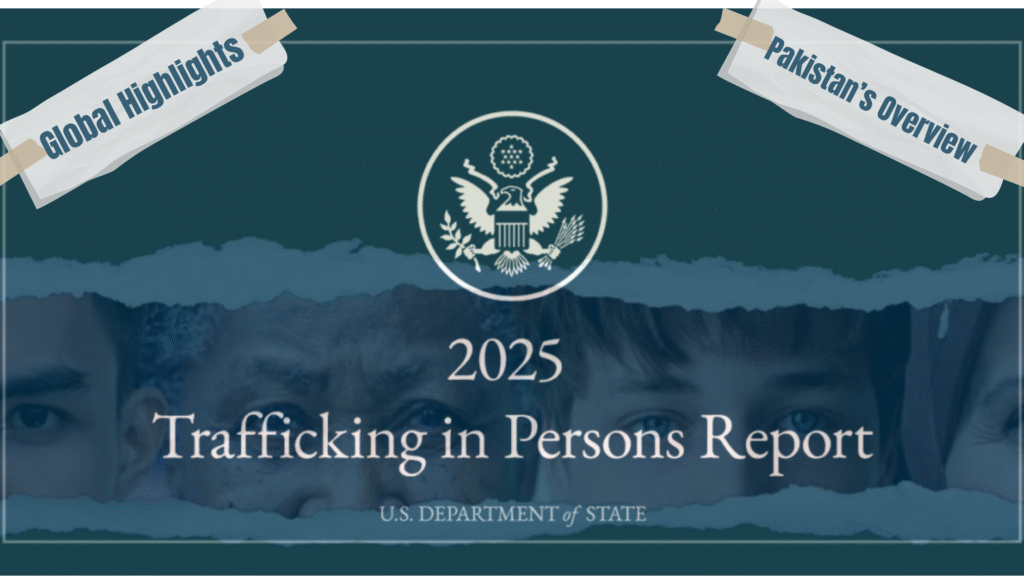
Trafficking in Persons (TIP) Report 2025 by US State Department – Key Highlights
Global Overview
- Total Countries Assessed: 188
- Reporting Period: April 2024 – March 2025
- 25th Annual TIP Report by the U.S. Department of State
- Objective: Evaluate global efforts to Prosecute, Protect, and Prevent human trafficking.
Global Tier Placements (2025)
| Tier | Description | Key Points |
| Tier 1 | Fully meets TVPA standards | 34 countries (e.g., U.S., U.K., Canada, Sweden, Germany) |
| Tier 2 | Making significant efforts | Majority of countries, including Pakistan |
| Tier 2 Watchlist | Limited progress, rising victim numbers | 20+ countries |
| Tier 3 | Not meeting standards or making efforts | 17 countries |
13 Countries with State-Sponsored Trafficking Patterns: Afghanistan, Belarus, Burma, Cambodia, China, Cuba, Eritrea, Iran, DPR Korea, Russia, South Sudan, Sudan, Syria.
Key Global Statistics (2024 Reporting Year)
| Indicator | Number / Trend |
| Total Prosecutions | 15,791 |
| Labor Trafficking Prosecutions | 4,024 |
| Total Convictions | 7,975 |
| Labor Trafficking Convictions | 1,476 |
| Victims Identified | 102,027 |
| Labor Trafficking Victims Identified | 27,759 |
| New or Amended Laws | 16 |
| Estimated People in Forced Labor (ILO) | 21.3 million |
| Annual Profits from Forced Labor | $236 billion |
Regional Breakdown (2024)
| Region | Prosecutions | Convictions | Victims Identified |
| Africa | 3,541 | 1,115 | 11,383 |
| East Asia & Pacific | 2,933 | 2,357 | 3,611 |
| Europe & Eurasia | 2,960 | 1,674 | 18,865 |
| Near East (MENA) | 1,743 | 990 | 4,447 |
| South & Central Asia | 2,754 | 1,177 | 41,304 |
| Western Hemisphere | 1,860 | 662 | 22,417 |
Highest Victims Identified: South & Central Asia (includes Pakistan).
Progress Over the Years (2018–2024)
| Year | Prosecutions | Convictions | Victims Identified |
| 2018 | 11,096 | 7,481 | 85,613 |
| 2019 | 11,841 | 9,548 | 111,932 |
| 2020 | 9,876 | 5,011 | 109,216 |
| 2021 | 10,572 | 5,260 | 90,354 |
| 2022 | 15,159 | 5,577 | 115,324 |
| 2023 | 18,774 | 7,145 | 133,939 |
| 2024 | 15,791 | 7,975 | 102,027 |
Emerging Global Trends (2025)
- Forced Criminality: Victims compelled into criminal acts; call for non-punishment policies.
- Technology & AI: Used for recruitment and exploitation; also aiding detection.
- Conflict & Climate: Displacement heightens trafficking risk.
- Supply Chains: Forced labor profits exceed $236B; new import bans by U.S. & EU.
- Fishing Industry: Among highest-risk sectors globally.
Peacekeeping Accountability (2024)
| Organization | Personnel | SEA Allegations | Notes |
| United Nations | 68,418 | 102 | 125 victims (27 children), mostly in DRC & CAR |
| OSCE | 2,243 | 0 | Updated whistleblower & PSEA rules |
| NATO | 9,243 | 0 | Mandatory SEA prevention training |
International Legal Commitments
| Country | UN TIP Protocol | ILO Forced Labor Conv. | ILO Protocol 2014 | CRC Optional Protocols |
| Pakistan | 2022 | 1957 | Effective 2026 | 2011 (Sale of Children); 2016 (Child Soldiers) |
Key Policy Directions
- Strengthen labor trafficking enforcement and data transparency.
- Apply non-punishment principle for victims.
- Integrate trafficking prevention into conflict, migration, and climate frameworks.
- Use AI and cyber tools ethically to detect trafficking networks.
- Expand survivor advisory councils in every region.
- Promote global supply-chain due diligence laws.
Pakistan’s Overview
2025 Trafficking in Persons (TIP) Report – Pakistan
Tier Status & Overview
- Tier: 2 (Remained on Tier 2)
- Status: Pakistan does not fully meet the minimum standards for eliminating trafficking but is making significant efforts.
- Progress: Increased prosecutions, convictions, victim identification, and funding for services.
- Key Legislative Step: Amended Prevention of Trafficking in Persons Act (PTPA) – raised penalties and removed option of fines in lieu of imprisonment.
Key National Figures (2024 Reporting Year)
| Indicator | 2025 Report Figure | Change vs 2023 |
|---|---|---|
| Trafficking Cases Investigated (PTPA) | 1,607 (523 sex trafficking, 915 forced labor, 169 unspecified) | ↑ +1% |
| Total Prosecutions (PTPA) | 1,310 (347 sex trafficking, 727 forced labor, 236 unspecified) | ↓ -9% |
| Total Convictions (PTPA) | 495 (60 sex trafficking, 434 forced labor, 1 unspecified) | ↑ +41% |
| Cases under PPC | Investigations: 23,629 | |
| Prosecutions: 22,027 | ||
| Convictions: 263 | ↑ +5% | |
| Total Victims Identified | 37,303 | ↑ +28% |
| Sex Trafficking Victims | 26,613 (3,498 men, 21,069 women, 1,046 children) | ↑ +26% |
| Forced Labor Victims | 9,917 (3,975 men, 4,761 women, 1,181 children) | ↑ +30% |
| Unspecified Victims | 773 (321 men, 357 women, 95 children) | — |
| Victims Referred to Services | 35,055 | ↑ +37% |
| Victims Receiving Services | 31,050 (22,300 sex trafficking, 8,476 forced labor, 274 unspecified) | ↑ +21% |
| Free Legal Aid Provided | 8,356 victims | ↑ +20% |
| Officials Investigated for Complicity | 8 investigated, 80 dismissed | — |
| Provincial Victim Assistance Funding | 709.2 million PKR ($2.52M) total | ↑ +63% |
Regional Hotspots and Patterns
- Sindh & Punjab: Core of bonded labor and child labor (brick kilns, agriculture).
- Khyber Pakhtunkhwa: Migrant and refugee vulnerability, domestic servitude.
- Balochistan: Transnational trafficking through border zones, weak shelter capacity.
- Urban Centers (Karachi, Lahore, Multan): High rates of sex trafficking, forced begging.
Major Improvements (2025)
- 37,303 victims identified, 495 convictions, and 1,310 prosecutions mark clear progress.
- PTPA Amendment: Added “organized beggary” to trafficking definition.
- Provincial Coordination: Punjab established Special Committee to Counter Human Trafficking & Smuggling.
- FIA Expansion: 20 Anti-Human Trafficking Circles (AHTCs) in 7 zones.
- Victim Services Expansion: 105 government and NGO shelters; 35,000 victims referred.
- Budget Increase: Provincial victim protection allocations rose by 63% year-over-year.
Persistent Challenges
- Bonded Labor & Domestic Servitude: Remain under-prosecuted despite widespread scale.
- Labor Inspections: Inadequate funding, lack of authority to remove victims.
- Official Complicity: Persistent corruption, especially in Sindh brick kilns and farms.
- Limited Shelter for Male Victims: Male survivors under-supported.
- Conflation of Trafficking with Smuggling: Skews data and weakens enforcement.
- Afghan Refugees: 2.5M at heightened risk; lack of trafficking screening upon deportation.
Prevention & Institutional Measures
- National Coordination Committee on Trafficking in Persons (NCC-TIP): Meets regularly, chaired by Minister of Interior.
- National Action Plan (NAP 2021–2025): Implementation continued with provincial points of contact.
- Risk Analysis Unit (RAU): Created within FIA to assess trafficking risks and border vulnerabilities.
- Hotlines: FIA’s national anti-trafficking hotline received 33 calls in 2024; multiple provincial helplines active.
- Awareness Campaigns: Ongoing across provinces, targeting domestic servitude, forced labor, and migrant safety.
Sectoral Vulnerabilities and Victim Profile
| Sector / Context | Key Exploitation Type |
|---|---|
| Brick Kilns & Agriculture | Bonded labor affecting entire families; 4.5M trapped workers. |
| Domestic Work | 8.5M domestic workers; 1 in 4 households employs a child; high abuse risk. |
| Forced Begging | Children (esp. with disabilities) forced to beg by organized networks. |
| Textiles, Carpets, Bangles | Hidden forced labor; production moving to private homes. |
| Construction, Mining, Fishing | Debt bondage and unsafe working conditions. |
| Sex Trafficking & Fraudulent Marriages | Women trafficked to China; local sex trade near hotels and shrines. |
| Migration-Linked Trafficking | False job offers leading to forced labor in Gulf, Iran, Burma, and Kenya. |
| Refugees & Minorities | Afghans, Rohingya, Hindus, Christians face exploitation due to documentation gaps. |
Key Recommendations (TIP 2025)
- Strengthen prosecutions of bonded labor and domestic servitude under PTPA.
- Empower labor inspectors with resources and authority for referrals.
- Implement SOPs & NRM consistently nationwide.
- Expand shelters and vocational services for all genders.
- Register brick kiln and farm workers for protection and aid access.
- Train law enforcement and judiciary on victim-centered approaches.
- Eliminate recruitment fees and lift bans on women’s migration for work.
- Screen Afghan returnees for trafficking risk indicators.
- Public awareness on bonded labor, forced begging, and domestic servitude.
- Implement victim-witness protection in prosecutions.
Source: Based on U.S. Department of State, Trafficking in Persons Report 2025
(https://www.state.gov/reports/2025-trafficking-in-persons-report/)
(https://www.state.gov/reports/2025-trafficking-in-persons-report/pakistan/)