
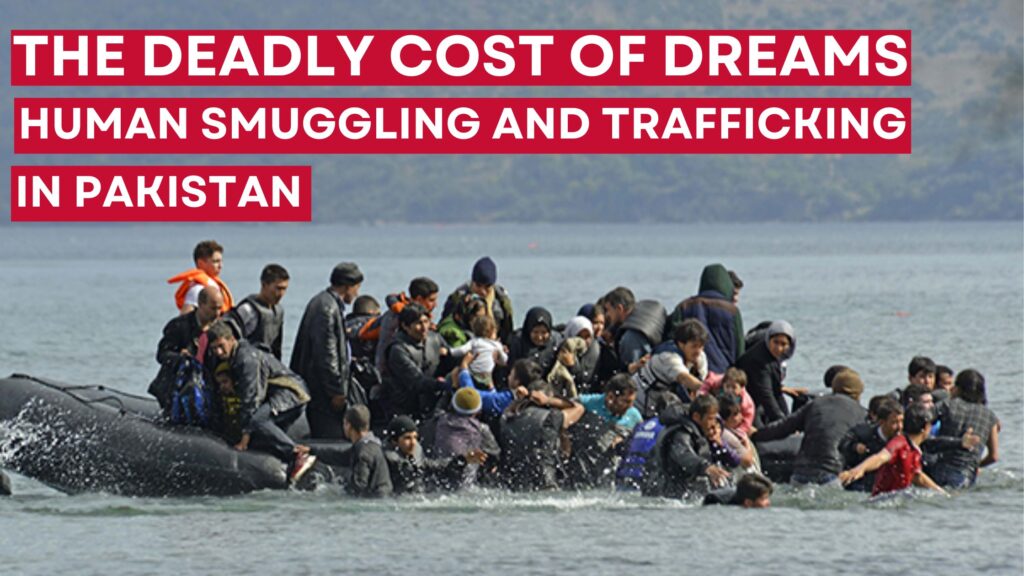
Every year, thousands of people risk their lives on dangerous journeys chasing a better future. Many imagine Europe as a land of success and wealth, where life is full of charm and happiness. But for many of them this dream turns into a nightmare, instead of prosperity they face sorrow. They bear financial loss, exploitation or even death.
At the core of this issue two crimes start to intersect: human smuggling and human trafficking. Smuggling usually starts voluntarily when people pay agents to take them across borders illegally, hoping for a heaven on the other side. Trafficking, however, is far darker in this process of profitability, the agents handover these clients to the traffickers, who exploit them in every possible way and then demand money from their loved ones. Most of the clients of smuggling end up as the victims of trafficking and eventually lose their freedom and saving they already have.
So why do Pakistani people still take this risk? Poverty and unemployment is the strongest reason, especially Punjab and Balochistan, where entire communities look toward Europe as a path to prosperity. Social pressure adds fuel to fire, in places like Gujarat and Mandi Bahauddin, seeing neighbors and friends building giant villas and buying expensive cars, building up a mountain of expectation for Europe: if they can make it, why not me.
Smugglers sell their services on the basis of these expectations. They use flashy promises, often through social media or word of mouth, that traps people to start this dark journey.
What begins as a deal with an “agent” turns into something terrifying. Migrants are handed from one smuggler to another across multiple countries. If the promised payments are delayed or the family fails to send money on time, the migrant is punished. Survivors tell their story and mention of beating, starvation and being locked up. Some migrants are pushed into labor or sexual exploitation to pay the loans that they never took. Others are simply abandoned into countries on the way to their destination.
Behind it all lies a highly organized business, smuggling in not the work of a few individuals but an entire network of smugglers. Guarantors handle money to reduce the risk for the smugglers while leaving migrants fully vulnerable. Corruption at borders ensures that this trade keeps running smoothly. Those who can pay higher upfront amounts to the smugglers may get a slightly safer environment, but the poor often face the worst conditions , a cruel reminder that money determines how much your life is worth.
The cost of this system is written in tragedies we all have seen in the news. In Greece boat disaster 2023 hundreds of Pakistani people lost their lives. The same year, another ship sunk in Libya killed dozens more. In 2024 a failed attempt to Morocco led to the death of 50 Pakistanis. Behind each statistic there is a family who not only lost their loved one but also lost their savings – often money borrowed at high interest or mortgaged against their property. They handed over their savings to the smuggler who vanished without accountability.
Stopping this exploitation is not easy because of the networks behind it, that are deeply rooted in Pakistan’s social and economic fabric. Smuggling is not carried out by an individual, but by well connected groups who move people across borders with the help of transporters and corrupt officials. Families often know who these agents are in their own districts but these families are helpless because of the power of the links of those smugglers. Even when the tragedies strike – like the Greece boat disaster or the Morocco shipwreck – the masterminds remain untouched, while only a few low level facilitators are arrested.
But there are ways forward. Experts came up with some solutions: raising public awareness so people understand the real dangers of illegal migration, governments should collaborate with other countries to provide sustainable opportunities to the youth and closing the legal gaps that allow traffickers to operate freely. Since it is a crime that spreads across borders, that’s why international cooperation is very important – Pakistan cannot fight it alone.
At the end of the day, this issue is not only about laws or borders — it is about people and their broken dreams. What starts as hope for a better life often turns into suffering and abuse. Unless people are made aware of the risks, and real action is taken to protect victims and stop these networks, smugglers and traffickers will keep making money from the hopes and hardships of struggling families.

Shahzaib Hassan
Co-author and research assistant of this article

One Response
Reading this really hit me hard. We often hear stories about people from our own areas going abroad, but this article shows the painful reality behind those dreams. It’s heartbreaking to think how many families lose everything, not just money, but their loved ones because of smugglers and traffickers.
I really appreciate how this article connects the bigger issues like poverty, unemployment, and social pressure with the human suffering that comes out of it. It’s a wake-up call for our generation to think differently and raise awareness so fewer people fall into these traps. Thank you for shedding light on something that many of us know exists but don’t fully talk about.